Note: This post was generated with AI tools for the sole purpose of demonstrating the rich typographic and mathematical capabilities of the Eyvan template.
The air at the edge of the Arctic Circle does not merely fill your lungs; it shocks the senses into a state of acute clarity. In the late autumn of 2025, I found myself standing on the basalt cliffs of Reykjanes, watching the North Atlantic smash itself to foam against rocks that are, geologically speaking, still in their infancy. Iceland is a landscape stripped of all ornamentation. Here, the planet’s molten spine breaks through the crust, creating a chaotic laboratory of steam, sulfur, and stone. To travel through this terrain with a camera and a notebook is to realize that the earth is not a static stage upon which life plays out, but a living, breathing entity undergoing perpetual transformation.
This post serves as both a creative field journal and a practical stress test for the Eyvan template’s reusable media tools: numbered figures, responsive image grids, embedded video, table captions, and cross-references. When documenting a landscape defined by scale and contrast, standard web layouts often fail to capture the sheer kinetic energy of the environment. Over the course of three weeks, I sought to blend long-form descriptive prose with diverse visual formats—ranging from high-resolution static frames and multi-image structural grids to responsive, high-definition video captures. The goal was simple: to build an immersive digital archive where text, imagery, and moving pictures do not merely coexist, but actively enrich one another’s narrative weight.
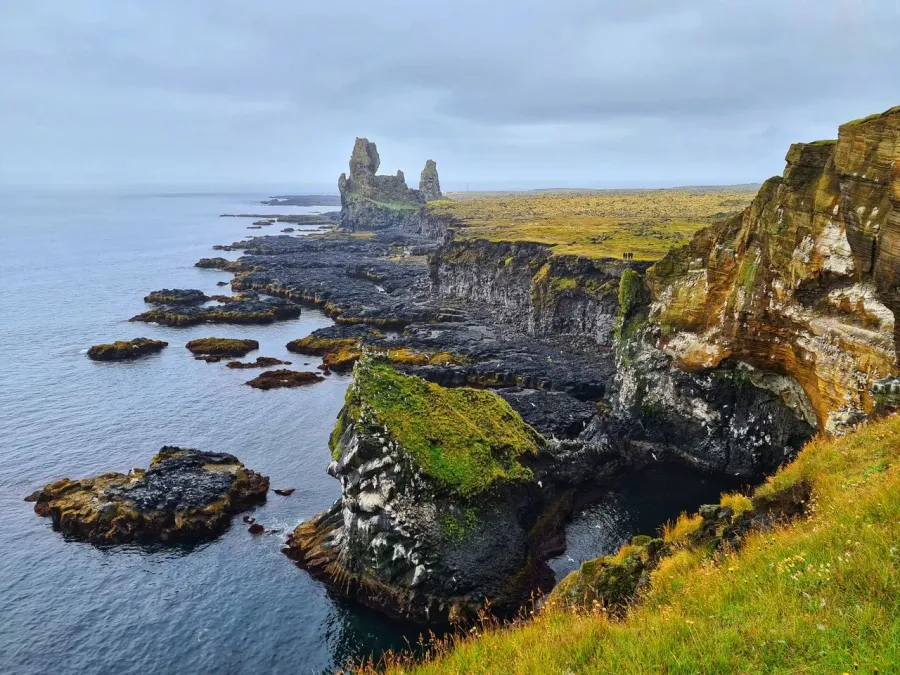
A spectacular view of the rugged basalt cliffs of Reykjanes, Iceland, meeting the ocean under a cloudy sky. This image (and the cover image) from Pexels by Lyn Ong (Aug 4, 2020), used under the Pexels License.
The Textures of Liquid Rock
To understand the Icelandic interior, one must learn to read the language of lava. The landscape is dominated by two common surface forms of basaltic flows: hella-hraun (smooth, ropey pāhoehoe) and apal-hraun (jagged, blocky ʻaʻā). Walking across an ancient apal-hraun field is a lesson in tactile geography. Every surface is razor-sharp, encrusted with a brittle layer of grey-green wool-moss (Racomitrium lanuginosum) that takes centuries to establish itself over the black glass. The contrast is conceptually striking—the softest, most fragile biological pioneer clinging to the hardest, most violent geological foundation.
The geometric perfection of columns at Reynisfjara. These basalt structures form via columnar jointing as thick lava flows cool slowly over months, contracting into distinct hexagonal geometric prisms. Image from Pexels by Batın Özen, used under the Pexels License.
When you isolate these structures through a lens, the scale becomes ambiguous. A close-up of a basalt joint looks identical to an aerial view of an entire canyon system. It is a fractal landscape where the micro mirrors the macro. This spatial disorientation is compounded by the quality of the Arctic light. During the shoulder seasons, the sun never rises high into the sky; instead, it scrapes along the horizon for six continuous hours, casting elongated, dramatic shadows that reveal micro-topographies invisible under a standard midday sun. Every grain of silica, every microscopic fissure in the stone, stands out in high relief.
Juxtaposition: Fire and Ice
Nowhere is the paradox of Iceland more evident than at the boundaries where active geothermal areas collide with glacial runoff. In the southern valleys, one can stand with one foot immersed in a freezing meltwater stream while the back of your neck is warmed by a plume of boiling, sulfurous steam rising from an unseen vent in the earth. The color palette of these zones defies the traditional expectations of a volcanic wasteland. Far from being monochrome, the earth bleeds deep ochres, vivid turquoise, and brilliant copper greens, all synthesized by the extreme chemical interactions occurring just meters beneath the surface.
To capture this intense material contrast, the post uses a two-column responsive figure grid. The side-by-side structure in fig-fire-ice provides an ideal framework for examining how these opposing environmental forces occupy the same geographic coordinates.
Fire and ice in the same frame: geothermal venting at Námafjall, where minerals stain the clay (left), and compressed ancient ice calving into the dark waters of Jökulsárlón (right). The left image from Pexels by Francesco Ungaro (Jun 29, 2017), used under the Pexels License, and the right image adapted from Wikimedia Commons by Kenny Muir (May 7, 2006), licensed under Creative Commons CC BY 2.0.
In the image on the left, the earth is actively destroying itself—acidic steam dissolving solid rock into bubbling, grey mud pools that smell intensely of elemental sulfur. In the image on the right, the process is reversed; centuries of compressed snowfall are preserved in the dense, oxygen-starved blue ice of the Breiðamerkurjökull tongue, slowly sliding toward its demise in a warming ocean. Both images represent different states of time. The geothermal vent is instantaneous, volatile, and immediate. The glacier is slow, historical, and structural, holding within its crystalline matrix the atmospheric data of past millennia.
Kinetic Horizons: The Moving Frame
While a photograph can freeze the stark geometries of the landscape, it fundamentally strips away the element of time. Iceland is not silent, nor is it still. It is a land of continuous, roaring motion. The wind is a permanent physical presence, molding the waves, driving the low clouds, and forcing the waterfalls to blow backward over the edges of the escarpments. To truly convey this sensory environment, video must be woven directly into the fabric of the text, functioning as an extension of the prose rather than an afterthought or an external link.
The embed in fig-coast-video uses the reusable video include in third-party mode, maintaining a strict 16:9 widescreen aspect ratio across all viewports to preserve the cinematic horizon of the southern coast.
The southern coast in motion — surf retreating across black volcanic sand at Reynisfjara, Iceland.
Watching the motion of water on black sand reveals patterns that a camera shutter can never capture. The white surf retreats over the volcanic grains, creating fleeting, intricate networks of fluid dynamics that mimic the branch-like structures of regional river deltas seen from space. This convergence of scales—where the motion of a single wave echoes the geometry of a continental drainage basin—is central to the experience of the Arctic landscape. The video framework must be robust enough to handle these complex high-frequency textures without compressing them into digital artifacts.
Sonic Field Notes: The Sound of Black Pebbles
Images and video capture Iceland’s visible drama, but the coast is also an acoustic landscape. At Djúpalónssandur, the ocean is not only heard as a distant roar; it becomes a close, textured rhythm. Water breaks against the shore, then recedes through black pebbles in a frothy pattern of friction, pull, and return. The sound gives the landscape a physical scale that still images cannot fully carry.
The audio sample in fig-djupalonssandur-audio demonstrates the audio.html include using a local Opus audio file. This keeps the media lightweight while still allowing the post to include place-based sound as part of the field-note experience.
Ocean waves receding over black pebbles at Djúpalónssandur Beach, Iceland. Audio: Closer Ocean Waves on Pebbly Beach - Iceland (loop) by NickTayloe on Freesound, licensed under Creative Commons Attribution 4.0. Format converted from the original FLAC to Opus for web playback.
This sonic layer changes how the surrounding images are read. The basalt columns in fig-basalt become less static when paired with the repeated movement of water across stone. The landscape is no longer only a composition of cliffs, sand, ice, and light; it becomes a timed event, shaped by impact, retreat, and recurrence.
Testing Proportions and Spatial Dynamics
Reusable media components prove their value when they preserve a coherent visual rhythm across different providers and screen sizes. After the YouTube embed above establishes the template’s handling of a wide coastal horizon, the Vimeo capture in fig-canyon-video demonstrates that the same video.html include can embed a second platform while maintaining the same 16:9 structure, caption treatment, and responsive figure spacing.
A top-down shoreline study: white waves thinning across Iceland’s black sand in a high-contrast coastal frame.
In this footage, the emphasis remains on motion and contrast rather than on geological depth. From a top-down vantage, the viewer watches white surf dissolve into thin retreating lines across volcanic black sand, turning the shoreline into a study in texture, repetition, and tonal opposition. The key test here is structural consistency rather than a new aspect ratio: whether this page is viewed on an ultra-wide desktop monitor or a handheld mobile device, the responsive 16:9 container keeps the Vimeo embed aligned with the surrounding typography, preserving proportional balance without introducing layout drift between providers.
Local Motion: Strokkur as a Self-Hosted Video
Third-party embeds are useful when a video already lives on YouTube or Vimeo, but a portfolio template should also handle local video assets. A self-hosted video is especially useful for short project clips, field recordings, animation tests, and research demos where the media belongs directly to the site archive.
The local video in fig-strokkur-local-video tests the self-hosted mode of the video.html include. Unlike the YouTube and Vimeo examples above, this file is served directly from the site’s own assets folder while preserving the same responsive 16:9 frame, caption styling, and figure numbering.
Strokkur erupting in the Geysir geothermal area, Iceland. Source video: Geysir, Iceland, 2023 - Erupting geyser Strokkur by EvaL MiKo on Vecteezy, free video with attribution required. Converted from the original h264 source to WebM VP9 with Opus audio for lightweight GitHub Pages delivery.
This test is intentionally different from the embedded videos above. The browser now renders a native <video> element with local playback controls, a poster frame, metadata preloading, and fallback text. That makes it a useful check for whether the template handles self-hosted media with the same visual rhythm as externally embedded video.
The Triptych: Elements in Sequence
When compiling field notes, individual frames often gain meaning when placed in immediate sequence with others. A single photo of a landscape can feel isolated; a triptych, however, creates a visual sentence, encouraging the eye to scan from left to right, parsing relationships, shifts in light, and thematic connections. The three-column gallery in fig-triptych demonstrates our template’s capacity to handle dense spatial clusters, maintaining clean, uniform margins between independent visual assets.
Three scales of the Icelandic experience: the micro-texture of black volcanic sand, the lone timber church at Búðir dwarfed by ancient volcanic masonry, and the macro-scale aurora lighting the sub-arctic sky. The left image adapted from Imaggeo by Simon Thivet (Feb. 18, 2014), licensed under Creative Commons CC BY 3.0., the middle image from Pexels by Bogdan Giurca (Oct. 28, 2023), used under the Pexels License, and the right image adapted from Wikimedia Commons by Vaidyanathan and Archana (Sep. 15, 2018), licensed under Creative Commons CC BY-SA 4.0.
This sequence encapsulates the three distinct scales of the Icelandic experience: first, the micro-texture of the black volcanic sand beneath your boots; second, the isolated human architectural mark—a lonely timber church at Búðir—dwarfed by the ancient volcanic masonry behind it; and finally, the macro-scale of the cosmos, where the earth’s magnetic shield interacts with solar winds, lighting up the sub-arctic sky in brilliant green curtains of aurora. By aligning these frames in parallel, the template mirrors the cognitive process of exploration, shifting fluidly between the intimate, the cultural, and the universal.
Field Summary
A condensed log of the formats tested across the three-week expedition is given in tbl-formats.
Media formats stress-tested in this post, with their aspect ratios and narrative role.
| Media tool |
Example |
Aspect ratio / layout |
Narrative role |
figure.html |
fig-basalt |
Single image |
Isolated geological detail |
figure.html |
fig-fire-ice |
2-column grid |
Direct visual comparison |
video.html |
fig-coast-video |
16:9 YouTube embed |
Expansive coastal horizons |
video.html |
fig-canyon-video |
16:9 Vimeo embed |
Provider parity and responsive depth |
video.html |
fig-strokkur-local-video |
16:9 local WebM video with poster |
Self-hosted playback, poster frame, native controls, and local asset delivery |
audio.html |
fig-djupalonssandur-audio |
Local Opus audio file |
Ambient field recording and place-based sound |
figure.html |
fig-triptych |
3-column grid |
Sequential scale shifts |
Epilogue: The Transience of Stone
As the final light fades from the Reykjanes peninsula, the horizon dissolves into a continuous gradient of deep indigo and soft violet. It is easy to look at Iceland and see a wilderness that is brutal, cold, and utterly indifferent to human presence. Yet, there is a profound quietness that settles over these fields once the wind dies down. The stones, cold to the touch, still hold the abstract memory of the earth’s core. They remind us that our human structures, our personal timelines, and our technological frameworks are fleeting anomalies on a planet that measures its age in epochs and cycles of ash. Documenting this landscape is an exercise in humility; we do not capture the land, we merely record our brief passage across its surface.